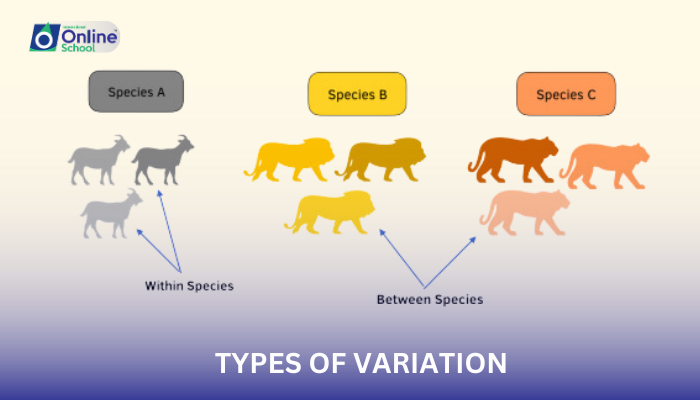
Learning Outcomes
i. Define continuous and discontinuous variation.
ii. Differentiate between continuous and discontinuous traits with examples.
iii. Understand the genetic and environmental factors influencing these types of variation.
i. Continuous Variation
Continuous variation refers to a type of genetic variation where a particular trait is distributed on a continuum. This means that the phenotypes are not discrete but rather fall within a range, often forming a bell-shaped curve when graphed. Height, weight, and IQ are classic examples of traits that show continuous variation. These traits are influenced by multiple genes (polygenic inheritance) and environmental factors, such as nutrition for height and weight, or education and socio-economic status for IQ.
ii. Discontinuous Variation
Discontinuous variation, on the other hand, is characterized by distinct and separate phenotypes with no intermediates. These traits are typically controlled by a single gene or a small number of genes, leading to a limited number of possible phenotypes. Gender and blood groups are examples of discontinuous variation. For instance, gender is determined by the presence of XX or XY chromosomes, and blood groups are determined by the presence or absence of certain antigens on the surface of red blood cells.
Examples Illustrating Continuous and Discontinuous Variation
Height: A trait that shows a wide range of phenotypes from short to tall, influenced by both genetic factors (like various growth factor genes) and environmental factors (such as diet and health during developmental years).
Weight: Similar to height, weight is influenced by a combination of genetic predisposition and lifestyle choices such as diet and exercise.
IQ (Intelligence Quotient): This is a measure of a person's intellectual capabilities and is influenced by both hereditary factors and environmental influences such as education.
Gender: A classic example of discontinuous variation, where individuals are biologically male or female based on their sex chromosomes, XX for females and XY for males.
Blood Groups: The ABO blood group system is an example of discontinuous variation, where individuals can only have one of the four blood types: A, B, AB, or O.
iii. Genetic and Environmental Influences
Continuous traits are usually quantitative and can be influenced by the environment, whereas discontinuous traits are qualitative and not usually influenced by environmental factors. However, it's important to note that some discontinuous traits can have environmental components, such as the expression of certain diseases that an individual may be genetically predisposed to but may only exhibit under certain environmental conditions.
In conclusion, understanding the types of variation is crucial for studying genetics, evolution, and population dynamics. Continuous variation provides a range of phenotypes that can be selected for or against in natural selection, while discontinuous variation can lead to distinct populations with specific traits. Both types of variation are important for the survival and adaptation of species.
